Class 17: Scrum Sprints
- Scrum
- Sprints
- Backlogs
- Planning
- Project Sprint Planning
- Risks
- Backlog
- Sprint 2 Planning
Overview: Scrum
Scrum
Scrum is a framework used by teams to manage work and solve problems collaboratively in short cycles.
Source: Microsoft
Scrum Lifecycle
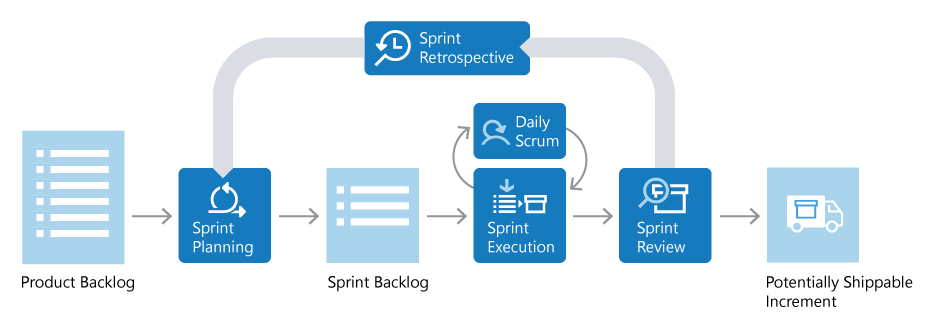
Sprints
Scrum sprints are short, time-boxed periods (often a week or two, but less than a month) where teams focus on completing a set amount of work, enabling incremental delivery.
Source: Atlassian
Sprint Planning
A collaborative process where the team defines the sprint goal, selects backlog items to work on, and creates a plan for how to accomplish the work during the sprint.
Your team must answer two questions:
- What work can get done in this sprint?
- How will the chosen work get done?
Gotcha: Once planning is complete, the sprint backlog is locked. No new work can be added to the sprint until the next planning session.
Product Backlog
A product backlog is a prioritized list of work derived from the roadmap, guiding development teams on what to deliver next.
Source: Atlassian
Team Project
Design and implement a prototype app that uses an LLM to support a user with a task.
Sprint 1 (Due 3/19): Teamwork + Proposal Sprint 2 (Due 3/26): ? Sprint 3 (Due 4/9): ? Sprint 4 (Due 4/16): ? Sprint 5 (Due 4/23): ? Sprint 6 (Due 4/30): User-Tested Fully Functional Prototype App
Prototyping Risks
When creating a prototype, you're trying to evaluate an idea. There are many unknowns.
What are some of the assumptions your team has made about the idea for your app?
What are some of the risks associated with those assumptions?
Address those assumptions and risks early in the process. Don't assume that your idea will simply work. Plan for failure and iterate quickly.
Activity: Identify Assumptions and Risks
Reflect on your team's app idea and identify at least three assumptions you've made about the idea on your handout.
For each assumption, identify at least one risk associated with that assumption and propose a way to mitigate that risk.
Discuss your assumptions, risks, and mitigations with your team.
Activity: Project Backlog Creation
Go to the board with your team and create a project backlog.
Write down the tasks that you think needs to be done for your project.
Include everything, including cool features you want to add, but also the basic features that you need to have for your app to work.
Activity: Backlog Prioritization
Now, prioritize the items in your backlog. Which items are the most important to complete first? Which items are less important and can be completed later?
Tip: Prioritize based on the assumptions and risks you identified earlier. What are the riskiest assumptions? What are the most important features to test those assumptions?
Activity: Sprint 2 Planning
Sprint 2 is due next Thursday (3/26). Plan out and commit to what your team will accomplish for Sprint 2.
Sprint Suggestion: Feasibility is a common risk for new app ideas.
Studio: Project Work Time
Use this time to work on your sprint 1 or sprint 2.
Repo: https://landrace.infosci.cornell.edu/courses/info4340-2026sp/repos/project
Coming Soon: Sprint 2 requirements