
Build smarter AI systems with technical and foundational expertise.

Designed for working professionals, Cornell's online Master of Science in Artificial Intelligence combines academic rigor with meaningful faculty engagement. Over 21 months, you'll develop expertise in artificial intelligence rooted in first principles — the mathematics, the architectures, and the evaluation - while exploring how AI can be applied to solve complex, real-world challenges. Specializations allow you to tailor your studies, extending your core AI training into focused methods and domains that align with your professional goals and interests.

Beginning in Fall 2027, the program includes two immersive one-week residential experiences where you'll collaborate with instructors, share capstone projects, and strengthen relationships with fellow students.


Deepen your AI knowledge with two degree options.

Cornell Bowers offers two online degrees in AI. Choose the program that fits your background, interests, and career goals.

  • The M.S. in Artificial Intelligence is designed for students who want to understand how AI works and build intelligent systems from first principles. 
  • If your goal is to apply AI within an established field or profession, the M.S. in Applied Artificial Intelligence helps you integrate AI into real-world practice and drive innovation in your industry.
Deepen your AI knowledge with two degree options.

Column Header:

M.S. in AI

M.S. in Applied AI

Overview:

Build AI systems from first principles — the mathematics, the architectures, the evaluation

Apply modern AI within your own professional field, and judge it well

Who's it For: 

Primarily focused on coursework with a capstone project that advances students' placement in industry jobs

Professionals in fields where AI is becoming essential: health, veterinary medicine, biology, agriculture, the natural and physical sciences, human resources, and more

Assumed Background: 

Basic programming, linear algebra, and statistics

None. No programming or mathematics prerequisites

Career Path:

Software engineer, machine learning engineer, AI engineer

Forward-deployed engineer, product manager, clinical AI specialist, AI policy & governance specialist

Format:

About 21 months — four semesters and one summer. Primarily online, with two one-week residential sessions

About 21 months — four semesters and one summer. Primarily online, with two one-week residential sessions

Cornell - shaping what's next in AI since 1956.

Division of Rare and Manuscript Collections Frank Rosenblatt ’50, Ph.D. ’56, works on the “electronic profile analyzing computer” – a precursor to the perceptron.

A history of AI innovation

Cornell University played a deeply foundational role in the development of artificial intelligence. In 1956, Frank Rosenblatt ’50, Ph.D. ’56 first demonstrated the perceptron - the first machine that could learn to classify what it saw. Every deep learning system in use today descends from that algorithm. Cornell went on to found one of the world's first computer science departments in 1965, and its faculty have twice won the Turing Award. 
Faculty at the forefront

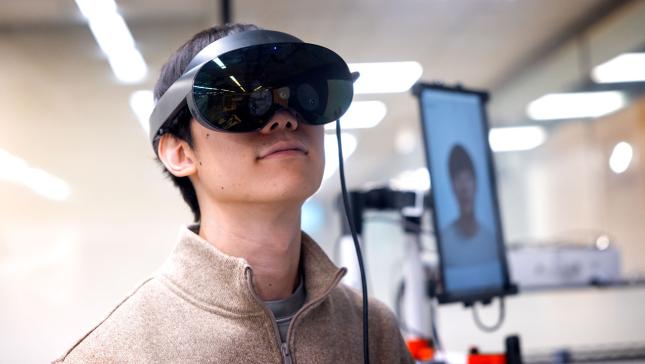
Artificial intelligence is the next technological revolution, empowering individuals to meet the challenges of the 21st century. Cornell Bowers faculty continue to innovate in the field of AI, conducting award-winning research in areas such as human-AI interaction, robotics, cybersecurity, computational sustainability, and AI trust and accessibility.