Speaker: Marirena Kladeftira, Assistant Professor, Design Tech, Cornell University
Title: From automation to collaboration to autonomy: Rethinking the future of making in construction
Time: 3-4 p.m.
Date: Nov. 18, 2026
Location: Computing and Information Science Building, Room 250
Click here to attend via Zoom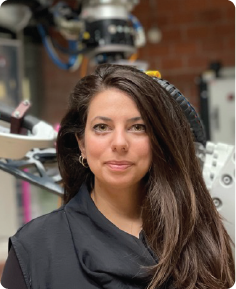
Abstract: Building more sustainably requires working with local resources, material variability, and situated knowledge. Yet construction automation has largely focused on standardized materials, predefined tasks, and predictable environments, often overlooking the adaptive nature and variability of building practices. As advances in robotics and physical AI expand machine capabilities, how can we design future systems that respond - or even embrace - the uncertainties of construction? How should tasks and agency be distributed between people and robots as skills and levels of autonomy change over time? Finally, how can we reduce the barriers of adoption of these new systems?
This talk argues that embracing uncertainty and hybridity is central to eco-social transformation in construction. I examine these questions through research on systems, tools, and frameworks for hybrid making. Fueled by advances in design computing, robotics, physical AI, and HCI, this talk will explore versatile computational tools, modular systems, as well as interfaces and workflows for human–machine collaboration in on-site construction. The presented work will make a case to support more adaptive, resource-conscious building practices, while raising broader questions about how interactive systems can offer new insights to the future of work in construction and increase accessibility and adoption of new technologies.
Bio: Marirena is a tenure-track Assistant Professor in the new multicollege Department of Design Tech at Cornell University, where she directs the Synergetic Systems Lab. Her lab develops computational tools, semi-autonomous systems, and interfaces for human–machine collaboration for sustainable and lightweight construction practices. Her research is interdisciplinary, bringing together people and expertise from architecture, media and design, and engineering, computer and information science. Central to her work is the notion of collective intelligence in construction investigating how tacit and embodied knowledge can be combined with increasingly capable and autonomous machines informing new approaches to design and making. Marirena’s work has earned recognition through publications, awards, invited talks, and exhibitions at prestigious venues, including the Venice Biennale, ZAZ Bellerive Museum, Kunsthalle Zurich, and the Swiss Sustainability Forum.
Marirena holds a doctorate from ETH Zurich as a doctoral fellow of the NCCR Digital Fabrication. Before joining Cornell, she was a postdoctoral researcher at EPFL, researching human-robot collaboration for adaptive fabrication, hybrid craft, and circular construction.

